
Adam’s artwork brings meaning, purpose, and self-expression: “Invisible does not mean imaginary”
November 6, 2026
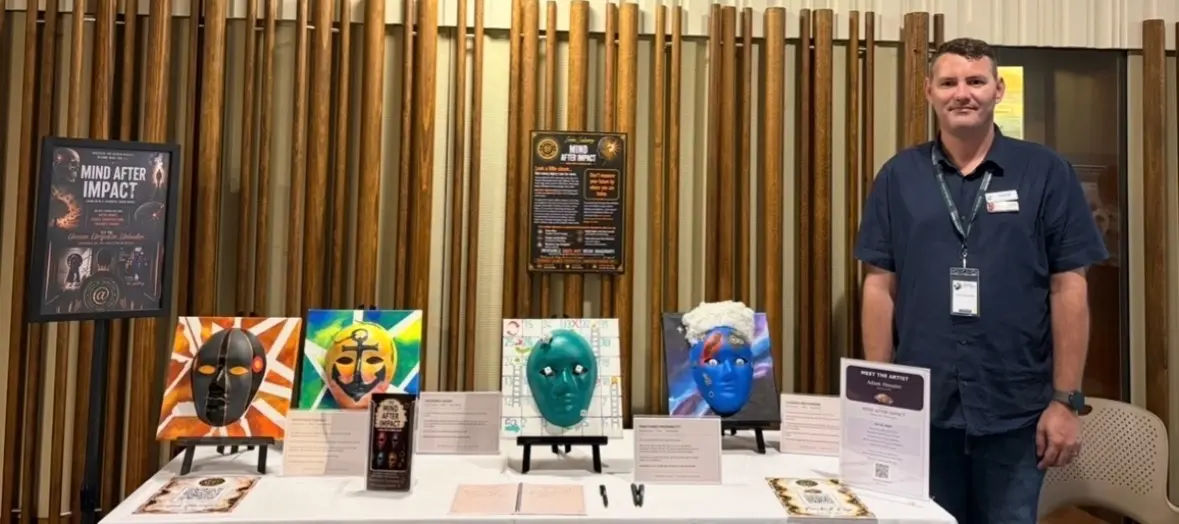
NIISQ participant Adam recently reflected on how art has brought meaning, purpose and self-expression following a serious motor vehicle accident in 2017. He also shares how NIISQ has supported him in rebuilding his strengths, enhancing his abilities and developing strategies to navigate ongoing challenges.
“Invisible does not mean imaginary.” — Adam
Living with a brain injury
Adam continues to live with pelvic pain, headaches and fatigue related to his traumatic brain injury, as well as sensitivity to light and noise. Processing information and managing emotions can be difficult, and car travel can cause significant anxiety and a heightened sense of alertness.
“These effects are not always visible. People may see me enjoying a conversation or creating artwork without seeing the preparation, assistance and recovery time involved. One demanding cognitive activity can use most of my energy for the day,” Adam said.
To help him navigate these challenges and continue pursuing his passions, Adam receives NIISQ-funded supports, including independent living assistance, occupational therapy, neuropsychology, exercise physiology and hydrotherapy. These services enable him to build routines, regain a degree of independence, and take part in meaningful activities.
“Each support has a different role, and it helps when the people involved work together. Understanding a strategy in a therapy session is one part of the process. Having support to practise and use it in everyday life is another,” he said.
Adam has worked with a neuropsychologist to help him understand how his brain injury affects him and develop strategies to manage emotions. His occupational therapist incorporates those strategies into therapy, supporting memory, fatigue management and daily routines. Both help train his support workers to provide consistent support.
“I have needed time, repetition and ongoing support to build insight and practise emotional regulation. Having worked with my neuropsychologist since 2018, I value the continuity and her understanding of my history,” he said. The hour-and-a-half drive into Brisbane for appointments is one example of gradual change. For around four years, distress about the journey could take up an entire session. Over time, Adam has been able to move beyond that distress and focus on other parts of his rehabilitation.
“For me, progress has been gradual. It has taken a long time to recognise and understand some of my difficulties, but I can now look back and see how far I have come.”
Building purpose and finding new strengths
Before his accident, Adam was career-focused, with little interest in hobbies or creative pursuits. However, after being unable to return to work, he began searching for new ways to use his abilities and find purpose in his life alongside rehabilitation.
This self-reflection led Adam to explore fluid art, primarily working with acrylic paint on canvas. Drawn to its movement, vibrant colours and abstract patterns, he has since expanded his practice to include mixed-media artwork.
“Art has given me a creative outlet since my accident. It gives me something meaningful to work towards and a way to express ideas and feelings that can be difficult to explain in conversation,” Adam said. “My inspiration comes from my experiences, emotions and the possibilities I see in colours and patterns. Some pieces explore joy and movement, while others have a more personal connection to my life after injury.”
Mind After Impact — Living with a Brain Injury art exhibition
Adam recently hosted an exhibition of his artwork, titled Mind After Impact — Living with a Brain Injury, at the Bold Ideas Better Solutions Symposium. The exhibition explored his experience of living with a brain injury. Adam met visitors, answered questions about his artwork, and attended symposium speeches.
The mixed media exhibition included four masks that explore different parts of Adam’s experience, from uncertainty and anxiety to pain and the unseen effort involved in everyday thinking. Written explanations, a reflection book and a short video accompany the masks.
“I hope the display will encourage conversations about invisible disability and help people understand the person behind the injury. It is also an opportunity for me to contribute my lived experience through something I have created.”
Adam said creating the exhibition brought together his art and strategies developed through rehabilitation.
“Creating the exhibition involved thinking carefully about difficult parts of my life and finding ways to express them visually. It was a meaningful project that brought together creativity and the strategies I have been developing through rehabilitation,” he said.
Adam’s NIISQ-funded occupational therapist supported him with the demands of the exhibition, including managing fatigue, memory, planning and breaking activities into manageable steps. The creative decisions and making of the artwork remained with him.
“My occupational therapist supported me throughout the process without doing the artwork for me. She helped me work through the demands of the project while keeping the creative decisions and making of the work in my hands,” he said. “That matters to me because the exhibition expresses my experience. Support helped me bring it together while allowing me to remain the artist and take ownership of what I created.”
Recognising progress and looking ahead
Adam is proud of the exhibition and the less visible progress he has made, including understanding his brain injury, developing strategies and working through difficult situations.
“Some achievements may look small from the outside, but I know how much time and effort they have taken.”
Looking to the future, Adam says he wants to continue developing his art and sharing his experience, while working on everyday independence, managing fatigue and using the strategies he has learned.
“Continuing to participate in life at a pace I can manage is an important goal in itself,”
For others living with brain injury, his advice is to allow time, seek people who understand their needs and explore activities that bring enjoyment or purpose.
“Explore activities that give you enjoyment or purpose. For me, that has been art. For someone else, it may be something completely different,” he said.
Asked what he would say to himself in the early days after his injury, Adam offers this message: “Don’t measure your future by where you are today. “I can create art, enjoy time with people and work towards goals while still experiencing pain, fatigue, anxiety and cognitive difficulties. Those experiences exist together.”
“Through sharing my story and Mind After Impact — Living with a Brain Injury, I hope to encourage greater understanding, patience and compassion. I also hope someone living with an invisible disability might recognise part of their own experience and feel less alone.”
A big thank you to Adam for sharing his inspiring story. For more details, including event recordings and a photo gallery, visit the Bold Ideas Better Solutions 2026 Symposium website.
Explore more of Adam’s incredible artwork on the Adam Hensler Art Facebook page
Last updated: November 2026